If you were recently jolted awake in the middle of a cold winter night by what sounded like a bowling ball dropping through your ceiling, or a rifle shot somewhere in the walls - you may have experienced a frost quake.
We know, because we caught one here in Blowing Rock. In January 2026, the same storm rolling through caused residents across Middle Tennessee to flood local weather services with frantic reports: mysterious booms shaking their houses, trees they assumed had fallen, sounds they couldn't explain.
The culprit wasn't a gas line, a fallen limb, or anything structural. It was the ground itself. Meteorologists confirmed what thousands of rattled homeowners couldn't have guessed: a cryoseism - a frost quake. The same conditions that triggered those reports in Tennessee reached into the Blue Ridge that same week.
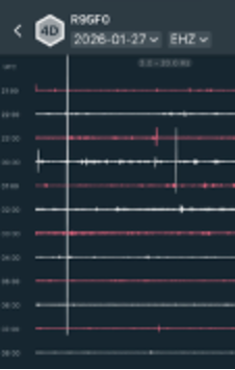
Our sensor in Blowing Rock captured it - a sharp, unmistakable impulse in the overnight data on January 27th, timestamped and logged while most of the neighborhood slept.
Why it happens here
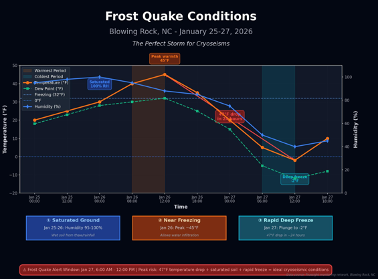
The main precursors are saturated ground from thaw or rainfall prior to a cold air mass moving in, minor snow cover without enough depth to insulate the ground, and a rapid temperature drop from near freezing to well below 0°F within 16 to 48 hours. That's a Blue Ridge winter almost exactly - wet soil from fall rain, thin snow cover at elevation, and the sharp overnight temperature swings that any seasonal homeowner in Blowing Rock knows well. The phenomenon is driven more by rapid temperature changes and soil moisture than by latitude alone, which is why southern states with unusually cold nights can experience them. The mountains of Western North Carolina check every box.
What it feels and sounds like
One climatologist described it as "somebody either snapping a very large branch off a tree or maybe popping very large bubble wrap - not quite gunfire, but it can be that loud." Shaking is less common: "those can be like small earthquakes, not nearly to the extent of where pictures fall off the wall."
The Tennessee reports for this storm matched this almost word for word - homeowners convinced a tree had come down on the roof, only to find nothing disturbed in the morning. If you were in Blowing Rock that night and heard something you couldn't explain, now you know.
What the data looks like
The seismograph image above is the real thing - captured locally on January 27, 2026 by our sensor in Blowing Rock. A frost quake registers as a sharp, sudden impulse, nothing like the rolling waveform of a tectonic earthquake and nothing like the gradual vibration of a passing truck or HVAC system. It's a clean spike in the overnight hours, no aftershocks, correlating precisely with the temperature record showing a rapid drop through freezing.
Cryoseisms are often mistaken for minor intraplate earthquakes - initial indications appear similar, with tremors, vibrations, and ground cracking - but the waveform signature and local weather conditions tell the real story. Having the data means you don't have to guess.