
On April 1, 2026, lightning struck a home in Blowing Rock and set it on fire.
Nobody was hurt.
Five agencies responded.
We were watching the storm arrive in real time.
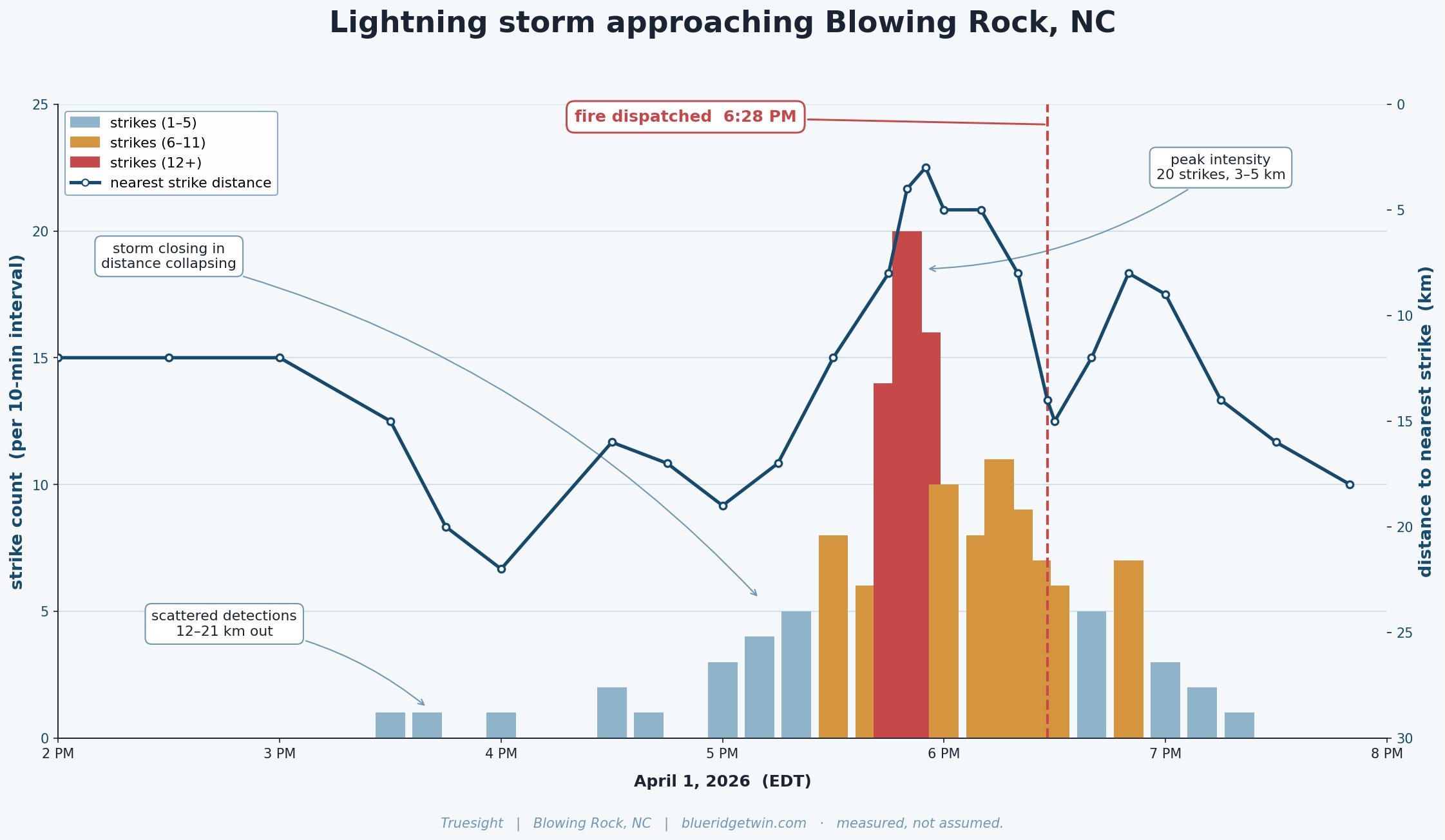
One of our monitored homes in Blowing Rock tracks lightning distance and strike count continuously. Here's what that day looked like:
Around 10:30 AM, the first detections - scattered strikes roughly 12 km out. Through the early afternoon, the storm crept closer. By 5 PM, strikes were stacking up fast: dozens of detections per interval, distance collapsing toward zero. The peak intensity hit between 5:30 and 6:30 PM - strikes within 5 km of the sensor, the highest count of the entire day. The fire department was dispatched at 6:28 PM.
What it feels and sounds like
This isn't unusual for the High Country. Blowing Rock sits at 4,000 feet on an exposed ridgeline — exactly the terrain that concentrates storm energy. We hadn't investigated lightning protection systems before this event, but they're now on our list. In conversations with several local builders, we learned that whole-house lightning protection is becoming a standard recommendation for new construction in the area - and it's easiest to install while the walls are open.
The damage you don't see
At another home we monitor in Blowing Rock, lightning had struck the chimney some time back, destroying the chimney and impacting two cars. That kind of damage hits hard and immediately. But the more common impact is the one nobody sees.
A single strike to a nearby tree or utility line sends transient overvoltage surging across the local distribution grid. Every home on that feeder segment is exposed - whether the owner is home or not. A voltage transient that degrades a compressor winding by a few percent. A surge that shortens your well pump controller's life. A refrigerator that fails six months later in a house that sat empty all winter.
Most residential panels have no transient suppression beyond the main breaker, which isn't designed for it. A Type 2 surge protective device at the panel is affordable and effective — we bundle one with our home power monitoring installation. It won't stop a direct strike, but it handles the far more common conducted surges from nearby events.
In closing
One honest limitation: our current residential power monitor samples at one-minute intervals. That's enough to catch sustained voltage sags from storm-related utility switching, but lightning transients happen in microseconds - far too fast for this sensor to capture. We have a reference-grade power analyzer arriving soon that samples at the waveform level. We're looking forward to seeing what the next storm reveals.
If you own property in the High Country, the question isn't whether your home will be near a lightning event. It's whether you'll know when it happens.
If you have someone you work with for lightning protection systems, please respond to the post and let me know or email me at info@blueridgetwin.com…I’ll add them to my list to investigate.