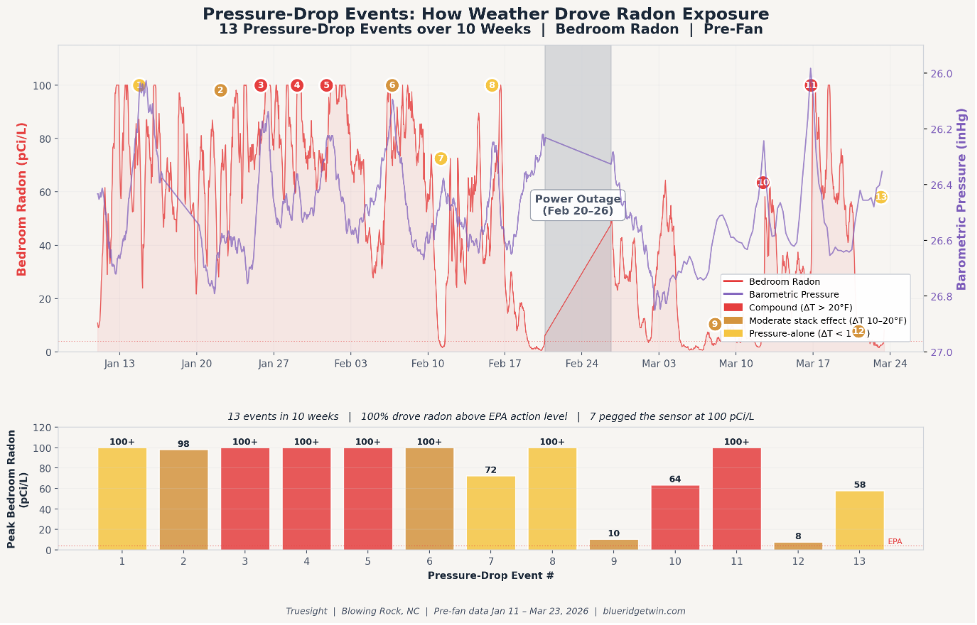
Every 5 to 6 days this winter, a storm front dropped the barometric pressure at one Blowing Rock home. Every one of those pressure drops drove the bedroom radon above the EPA action level. Seven of them pegged the sensor at 100 pCi/L.
That’s the finding.
Here’s how we got there.
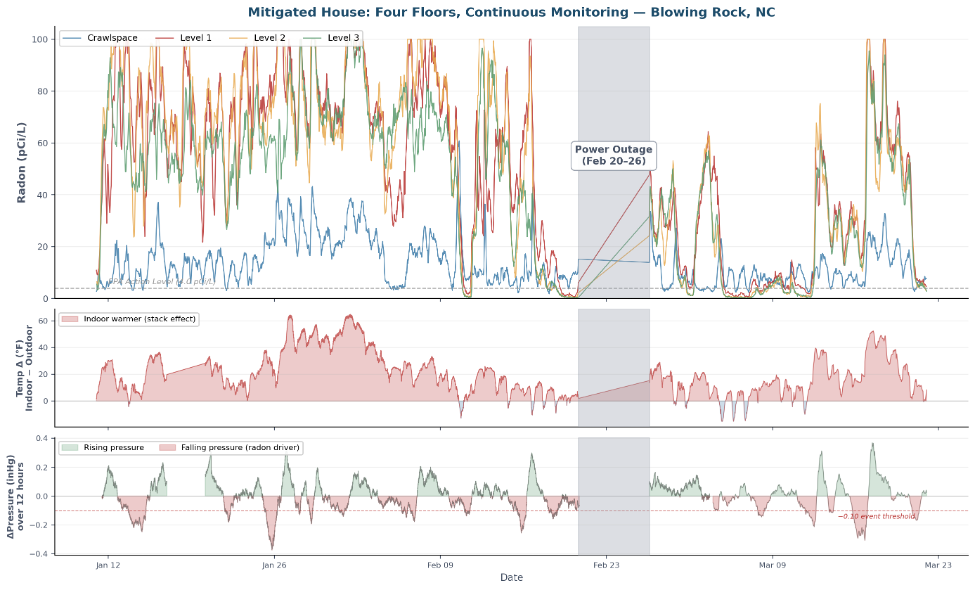
From January 11 through March 23, 2026, we continuously logged radon on three floors of the home, plus the crawlspace, alongside barometric pressure and indoor-outdoor temperature from a co-located weather station. 1,490 hourly readings, radon and atmospheric data logged in parallel. The home had an existing mitigation system that was failing. Heating season. The most active weather window of the year.
We defined a pressure-drop event threshold as any decline of 0.10 inHg or more over 12 hours. That’s the signature of a passing weather system, not a major storm, just the normal rhythm of mountain weather. We identified 13 distinct events.
The response was unambiguous:
• 13 of 13 events drove bedroom radon above the EPA action level (4.0 pCi/L)
• 7 of 13 pegged the sensor at 100 pCi/L, its physical detection ceiling. The real peaks were higher; we couldn’t measure them
• Average peak across all events: 78 pCi/L. Nearly 20x the EPA action level
The physics is straightforward. Soil gas exists in a pressure equilibrium with the atmosphere above it. When a storm front rolls in and drops barometric pressure, that equilibrium shifts… the soil exhales. Radon migrates upward through porous granitic bedrock and into every available entry point in the home’s foundation.
Here’s what surprised us.
We classified each event by its temperature context as well. Stack effect, the chimney-like airflow that drives more radon upward when indoor-outdoor temperature delta is large, is the other major radon driver in mountain homes. Of our 13 events: 5 occurred during strong stack effect (ΔT > 20°F), 4 during moderate stack effect (ΔT 10–20°F), and 4 during minimal stack effect (ΔT < 10°F).
The expected story is that compound events, pressure drop plus strong stack effect, would produce the worst readings. They did. But they weren’t alone.
Events in all three regimes pegged the sensor at 100 pCi/L. Some events with indoor-outdoor deltas of just 2–8°F still drove the bedroom past the measurement ceiling. Pressure alone, without stack effect pulling gas upward, was sufficient to drive maximum readings.
That changes how you think about risk. A pressure drop with no stack effect can hit the ceiling just as hard as one with a 50°F delta. Both showed up in our data. The weather doesn’t need to be extreme to trigger extreme exposure.
Here’s what this means for radon testing:
A standard 48-hour test averages whatever weather happens to occur during those two days. Run it during stable pressure and you’ll catch the baseline. Run it during a pressure trough and you’ll catch something closer to the peak. The same house can legitimately test at 2 pCi/L one week and 12 pCi/L the next. Nothing about the house has changed. Only the weather.
And in Western North Carolina’s granitic geology, the weather changes often. Every 5 to 6 days this winter, at this home, a passing pressure system triggered a radon exposure event above EPA action levels.
Single tests miss the events. For homes in this geology, the events are where the exposure lives.
Measured, not assumed.