This post is part 1 of 5 in a series on what continuous radon monitoring reveals about mountain homes.
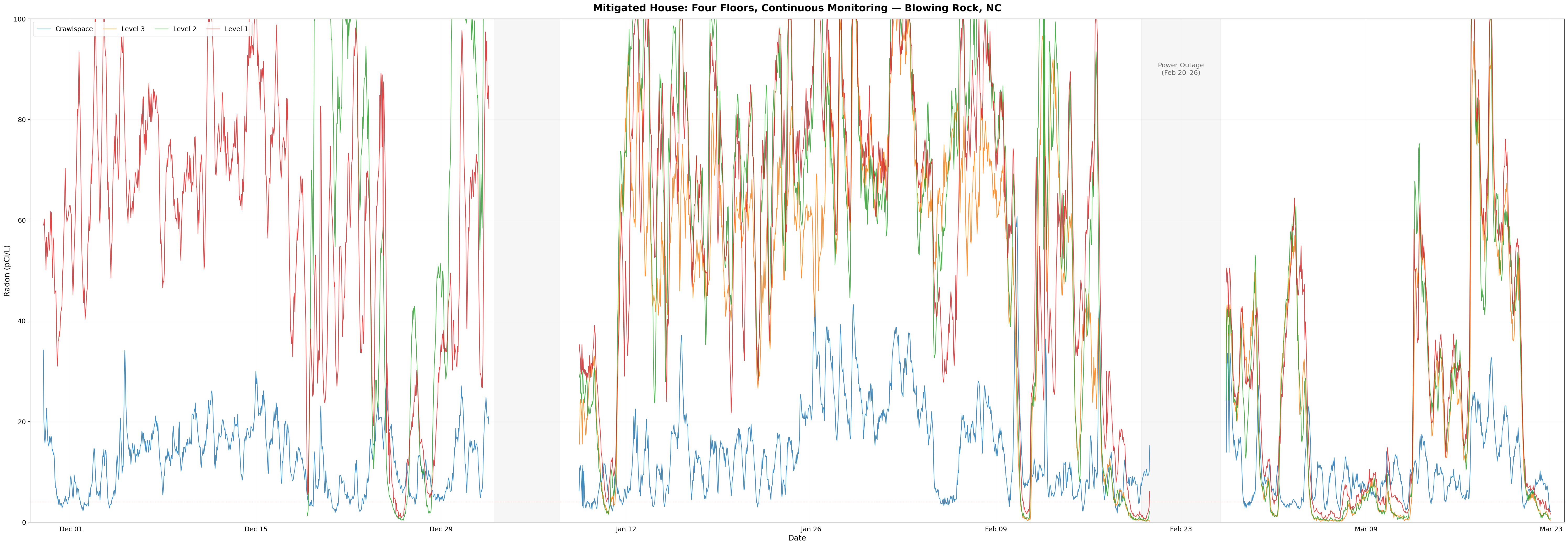
This home had a radon mitigation system. Installed by a reputable contractor. Annual inspections every year. Every recommendation followed.The bedroom was still pegged out at 100 pCi/L. Twenty-five times the EPA action level.
Your radon level right now has a driver, and it can change hour to hour according to the conditions outside.
We've been running four radon sensors 24/7 across multiple floors of one home in Blowing Rock, NC since late 2025.
Not a 48-hour test kit. Continuous, multi-point radon monitoring (along with our other sensor suites measuring temperature inside and out, barometric pressure, and radon fan power usage) through every weather pattern winter can throw at a mountain home.
When you collect that much data, you stop looking at radon as a single number and start classifying what's driving it.
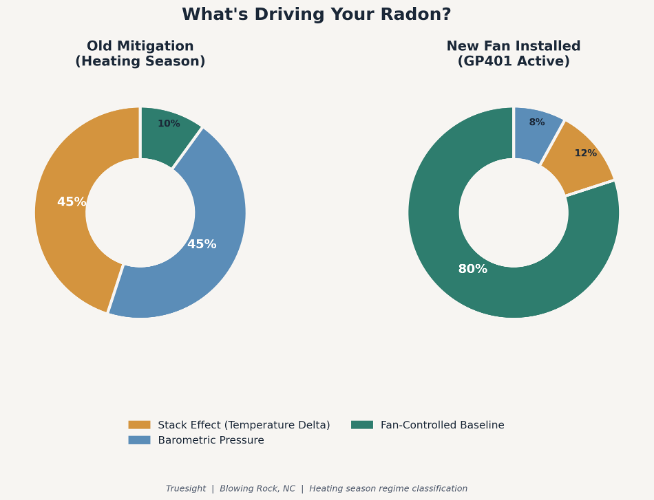
Every hour falls into one of three regimes:
Stack effect - When it's significantly colder outside than inside, warm air rises and exits through upper-level leaks. That creates negative pressure at the foundation, pulling soil gas upward through every crack and penetration. The effect scales with the temperature delta and the building height. At this home, crawlspace plus three above-grade floors, a delta of +21°F produced a spike to 34 pCi/L, over 8x the EPA action level. A January night in Blowing Rock can produce a delta of ~60°F. For homes without effective mitigation, or with systems that haven't been verified, that's the exposure window nobody's measuring.
Barometric pressure - When atmospheric pressure drops, such as when a storm front moves in, soil gas that was in equilibrium underground gets released upward. But it's not just the absolute level that matters. The rate of change is the better predictor. A drop of -0.10 inHg over 12 hours reliably triggered infiltration events at our site. Most approaching fronts were visible in the radon data.
Fan-controlled baseline - After installing a new radon fan, a third regime emerged: stable, low, and weather-independent. The fan maintains enough negative pressure beneath the foundation to override both natural drivers. Radon stays flat while barometric pressure swings and temperature deltas come and go.
Before the new fan, stack effect and barometric pressure traded dominance depending on season and weather, and the existing mitigation system wasn't stopping either one.
After the new fan, the fan baseline dominates and the weather-driven spikes largely disappear.
A single test captures one number from one moment in one regime. Continuous monitoring tells you which forces are actually driving your exposure, and whether your mitigation is holding against all of them.
This is the first in a series on what we've learned from continuous residential radon monitoring.
Next: the stack effect problem that seasonal mountain homeowners don't know they have.
Measured, not assumed.