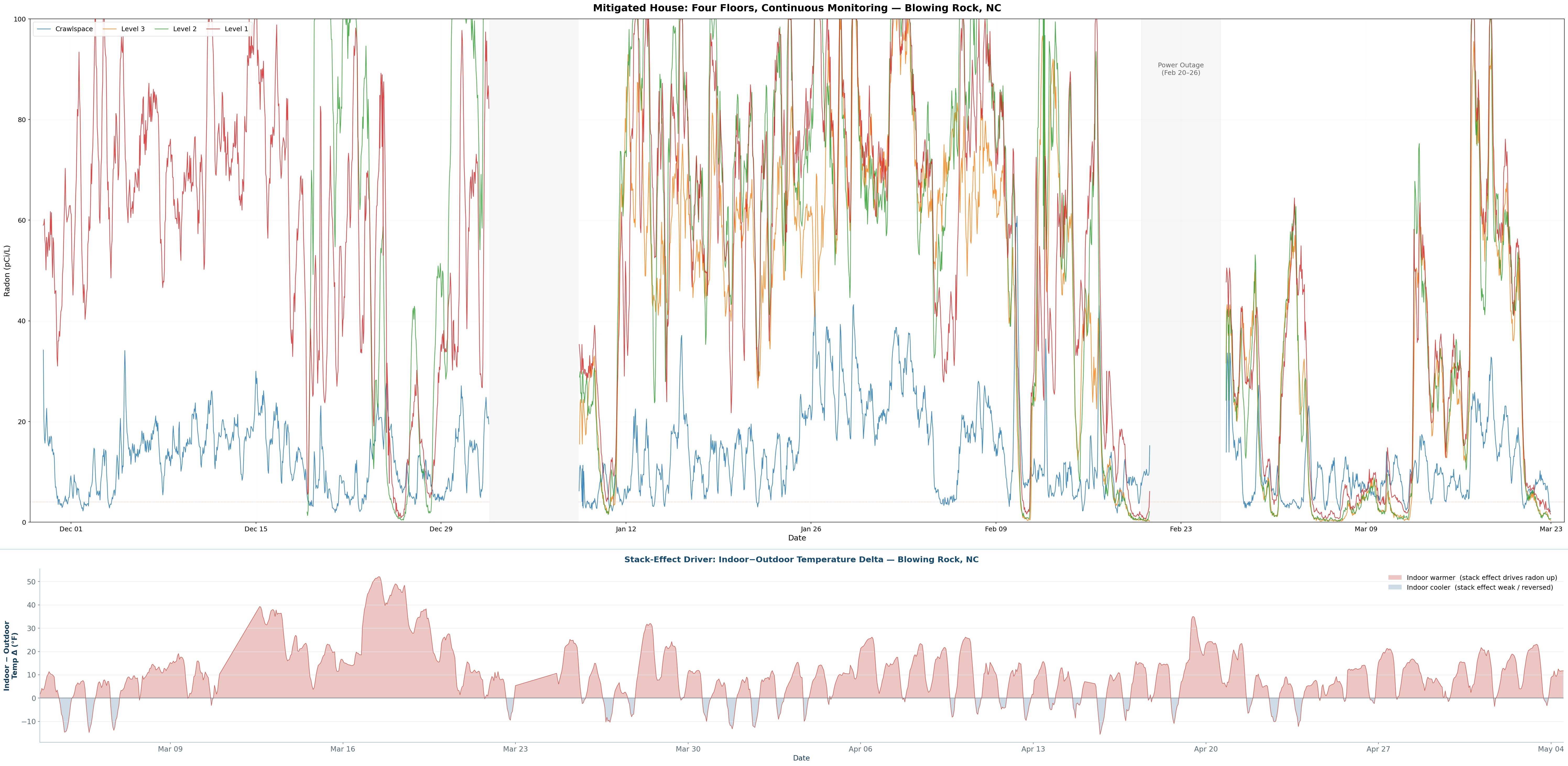
When it's 40°F outside and 65°F inside, your mountain home becomes a chimney, pulling radon through the foundation whether you are there or not.
The mechanism is called stack effect. Warm air rises and exits through upper-level leaks: attic penetrations, bathroom vents, ceiling fixtures. Replacement air gets pulled in at the lowest level. Through pipe penetrations. Through the gaps between the construction, the foundation walls, and even through walls below grade.
That replacement air comes from the soil. In Blowing Rock's granitic geology, it carries radon.
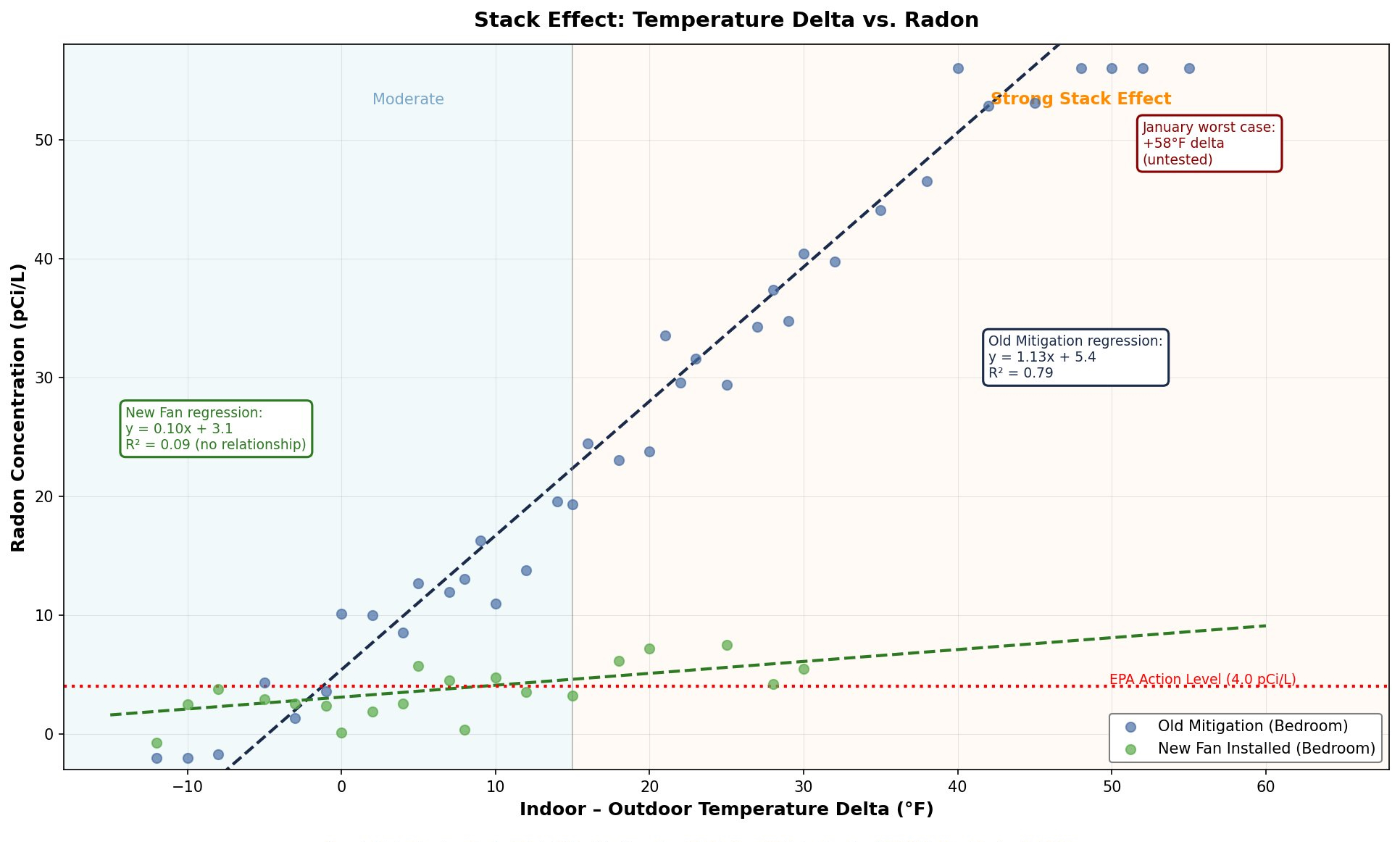
We've been tracking indoor temperature, outdoor temperature, and radon concentration simultaneously at a pilot home in Blowing Rock. The relationship follows a clear set of thresholds:
At 10-20°F, stack effect becomes a measurable infiltration driver. A cold fall evening with outdoor temps in the 50s is enough.
Above 20°F, stack effect dominates. Even if your radon level has been low and your fan has kept up...this is the real test. These differential temperatures vary by house. The general rule: the more floors, the lower the delta at which stack effect kicks in. This effect is also why it's important to have radon monitors at the lowest and highest living floors.
Here's what makes this interesting for seasonal properties: a January night in Blowing Rock can hit single digits. Indoor set to 55°F to prevent pipe freeze. That's still a +45°F delta, more than double what produced our worst recorded spike. Heat running. No occupants opening doors. No exhaust fans. No ventilation. Just radon accumulating.
Fast forward to the shoulder season, where stack effect can still be a real problem. Radon isn't a single number at your home. A single test kit deployed during a mild June visit tells you almost nothing about what that house does in February. The delta that drives your worst exposure is seasonal, weather-dependent, and invisible without continuous monitoring.
Measured, not assumed.